
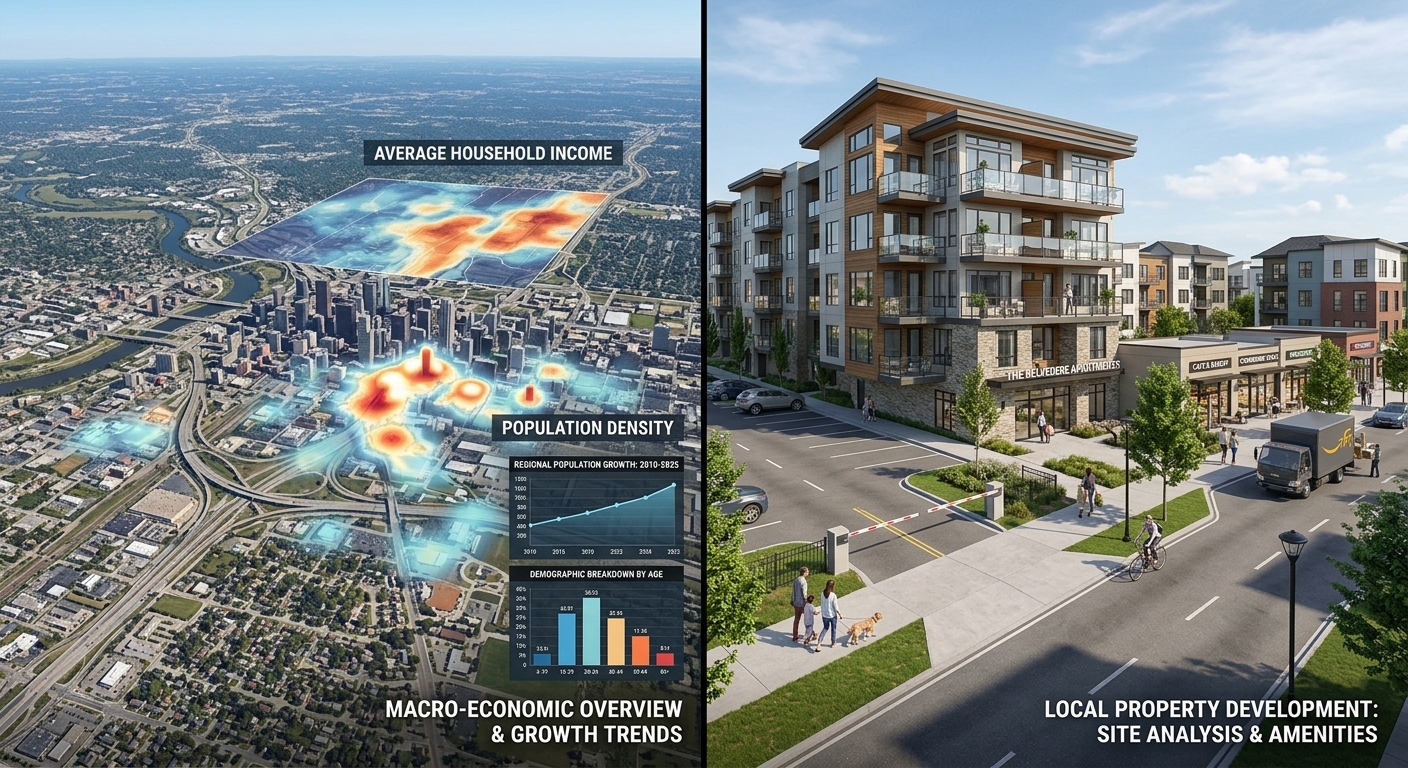
Population growth can help explain a region’s direction. It cannot, by itself, tell an owner where to build, what a tenant will pay or how quickly a project will lease.
For Omaha-area real estate, the next step is to connect the regional picture to the households, businesses and competing properties around a specific site.
Start with a consistent data set
The Census Bureau’s Vintage 2025 population estimates cover metropolitan and micropolitan areas through July 1, 2025. The bureau identifies that vintage as its latest completed, consistent set of estimates on the source page reviewed for this article.
The word “consistent” matters. The Census Bureau revises historical estimates when it releases a new vintage. Comparing a prior-year number from an older release with a current number from a newer release can produce a misleading growth calculation.
Use the same vintage, geography and reference dates when evaluating change. Also distinguish a city boundary from a county, metropolitan area or a property’s practical trade area.
Population is one input to demand
Our analytical approach is to move from people to the specific space they may need.
For housing, investigate household formation, household size, incomes and the supply of competing units. For neighborhood retail, examine nearby customers, spending capacity, travel patterns and existing alternatives. For employment-oriented space, evaluate the businesses and labor pool that can support occupancy.
A growing population does not automatically support every product type or price point. A project still needs a credible customer and a reason that customer would choose its location.
Test the site against the story
Consider two hypothetical sites in the same growing region. One has convenient access, available utilities and a use permitted under current zoning. The other requires major infrastructure work and an entitlement process before construction can begin.
Both can benefit from the same regional trend. Their timing, costs and execution risks can be very different. A population growth rate does not resolve those differences.
Before treating a growth corridor as an investment thesis, establish the addressable demand, the competing development pipeline and the cost of delivering usable space. Verify access, utilities, zoning and approval requirements with the appropriate local authorities.
Regional data helps identify where to investigate. Site-level evidence helps determine whether an opportunity is ready to pursue, needs a different plan or deserves more time.